The simplest rule for a Le Puy route packing list is weight: aim for about 10% of your body weight, which is 7 kg (about 15 lb) for a 70 kg walker, in a 30 to 40 litre pack. The French hiking federation, FFRandonnée, sets the ceiling at 20% for multi-day hikes, but on the GR65, where you sleep in gîtes every night, 10% is entirely achievable. The essentials fit in a few lines: broken-in shoes, two sets of clothes, a warm layer, rain protection, a sleeping sheet, a small first-aid kit, a water bottle, your pilgrim credential and some cash.
How much should your pack weigh on the GR65?
Camino preparation guides agree on the 10% rule. Decathlon puts it plainly: your pack "should not exceed 10%" of your body weight, adding that this is a guideline rather than a hard rule. The Viaje Camino de Santiago website gives the same limit, with a piece of advice worth remembering: leave everything you are packing "just in case" at home.
FFRandonnée, writing about multi-day hiking in general, allows more: up to 20% of the carrier's weight (11 kg for 55 kg, 16 kg for 80 kg). It advises against going further, up to a third of your weight, because of the risk of falls, sprains and tendinitis. That figure also covers self-sufficient hikers carrying a tent and stove. On the Le Puy route you find a bed and a meal every evening, so there is no reason to carry that much.
Which pack, and how to load it?
Decathlon recommends a capacity of 35 to 40 litres for the Camino. A bigger pack only tempts you to fill it. Choose one with a hip belt that transfers weight onto your hips, and try it fully loaded before you leave.
FFRandonnée gives a clear loading method: heavy items in the middle, against your back; sleeping sheet and spare clothes at the bottom; water, snacks, hat and sunscreen within easy reach; rain gear at the top. Keep documents in a zip-lock pouch, and line the inside of the pack with a heavy-duty bin bag, because water gets in through seams and zips.
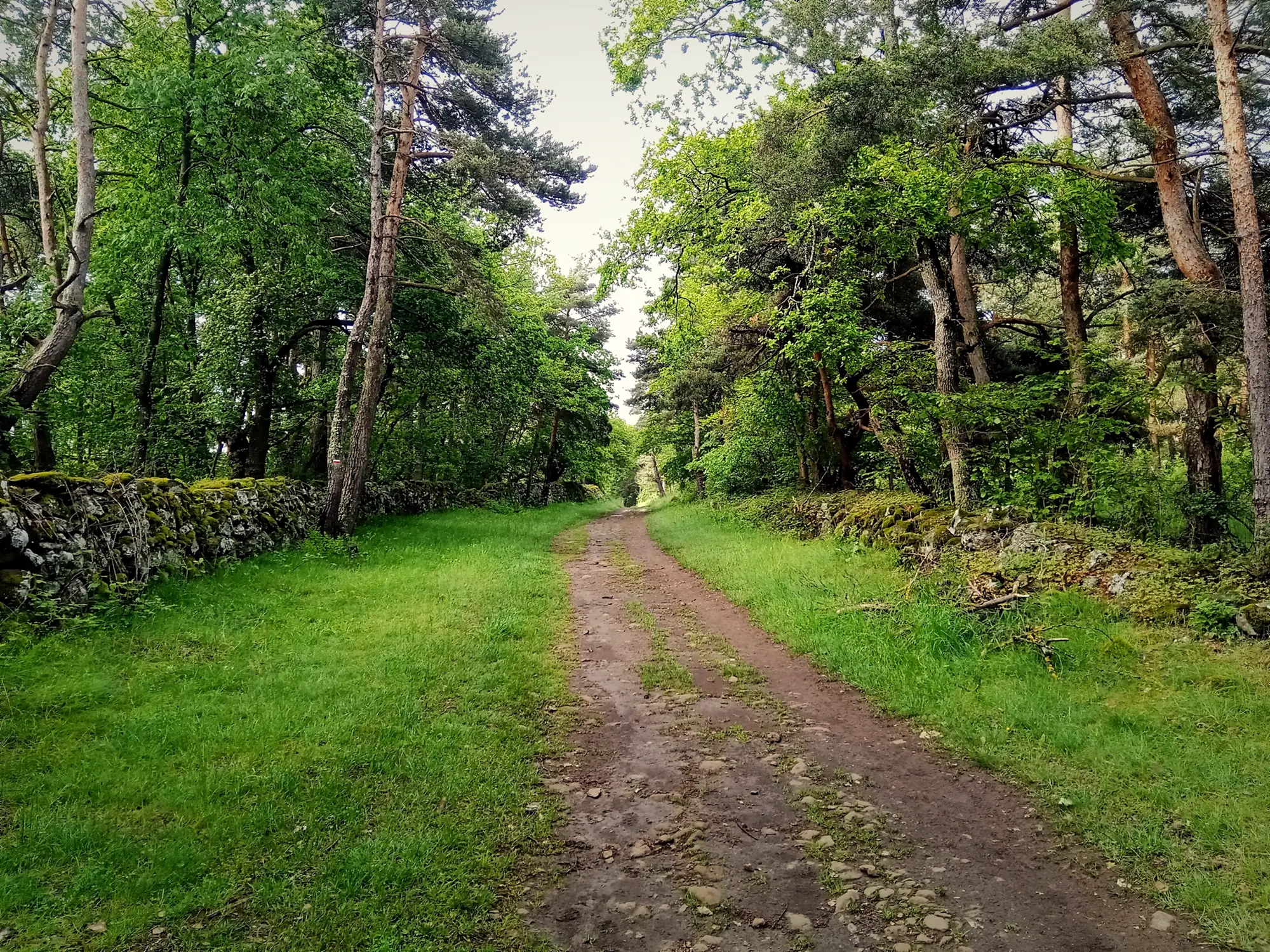
The complete GR65 gear checklist, by category
This is a core list for walking from gîte to gîte between April and October. It draws on the recommendations of Decathlon and FFRandonnée, adapted to the terrain of the GR65.
Carrying and walking
- A 30 to 40 L pack with a hip belt, plus a rain cover if your poncho does not cover it.
- Walking shoes that are already broken in (see below).
- Two or three pairs of hiking socks.
- A pair of trekking poles, "strongly recommended" by Decathlon, though not essential.
- Sandals or light shoes for the evening.
Clothing
- Two walking outfits: one to wear, one drying. Wash every evening.
- Trousers, ideally zip-off, handy when the temperature changes during the day.
- A warm layer that is quick to put on: fleece or light down jacket.
- A rain poncho or cape that also covers the pack.
- A sun hat or cap, plus a beanie and light gloves early or late in the season.
Night and washing
- A sleeping sheet (bag liner), often requested in pilgrim accommodation.
- A microfibre towel and a small wash kit.
- Earplugs for the dormitories.
First aid and safety
- Plasters, ideally blister plasters, anti-chafing cream, disinfectant and gauze.
- Any regular medication you take.
- A space blanket and a whistle, which FFRandonnée lists for any outing.
- Sunscreen.
Water and snacks
- A bottle or bladder: about 1 litre is often enough thanks to the fountains, but some stages call for 1.5 to 2 litres.
- A few snacks for the stretches without shops.
Documents, money, phone
- ID or passport, described as "essential" by Decathlon.
- Your pilgrim credential, to be stamped along the way (see our guide to the pilgrim credential on the Le Puy route).
- For European visitors, your European Health Insurance Card (EHIC). The French agency CLEISS stresses that it is not a substitute for private travel insurance and does not cover rescue or repatriation, so take out travel insurance too.
- Cash and a bank card.
- A phone and charger, and perhaps a paper guide such as the French Miam Miam Dodo (Éditions du Vieux Crayon), which lists accommodation, restaurants and services.
What do the items that matter weigh?
Weights vary too much from one model to another to give an honest figure for every item. Here are only the benchmarks we can justify, and what each item changes on the trail.
| Item | Indicative weight | Useful for |
|---|---|---|
| Full pack, water included | ≈ 10% of body weight (7 kg at 70 kg) | Coping with stages of roughly 20 to 27 km |
| Water | 1 kg per litre | Climbs with no shops, like Monistrol to Saugues |
| Trekking poles | Depends on model | Steep descents into the Allier gorges, your knees |
| Warm layer | Depends on model | Cool mornings on the Margeride and Aubrac |
| Poncho or cape | Depends on model | Rain and wind on the plateaus, keeping the pack dry |
| Sleeping sheet | Depends on model | Gîtes that require one, hygiene |
| Spare shoes | Depends on model | Resting your feet in the evening |
Water is often the heaviest thing in the pack: two litres weigh two kilos. That is why it pays to know where the fountains are rather than carrying too much "to be safe".
Hiking boots or trail runners?
This is the great debate of pilgrim forums, and there is no official winner. Decathlon sums up the trade-off: high-cut boots are "less light and less flexible" but hold the foot better, while low trekking shoes suit gentler paths. Many walkers now set off in trail runners; others swear by high ankles, especially with a heavier pack.
On the GR65 the surface alternates between small roads, dirt tracks and rocky sections such as the descent from Rochegude. The one point everyone agrees on: never start in new shoes. Do several walks in them, with a loaded pack, before you leave.
What to leave at home
- Everything "just in case": you can find the essentials along the way.
- A sleeping bag, if you are staying in gîtes: blankets are generally provided.
- Extra clothes: two outfits washed every evening are enough.
- Expensive, heavy devices (camera, laptop, drone): your phone handles photos, maps and emergency calls.
- Drinks other than water, which you can buy on the way.
- A tent and stove, unless you plan to bivouac.
What the descent into Monistrol and the climb to Saugues teach you
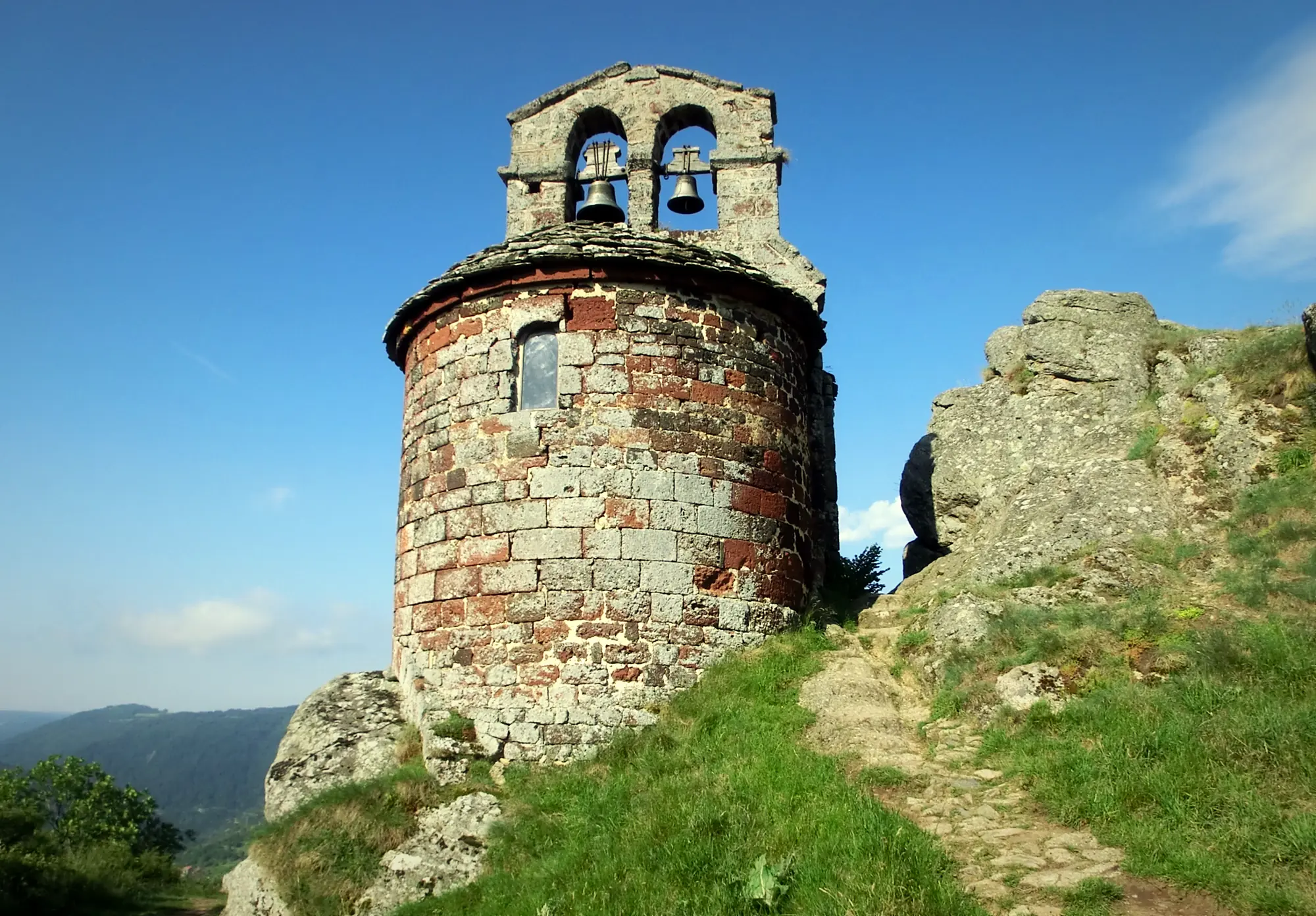
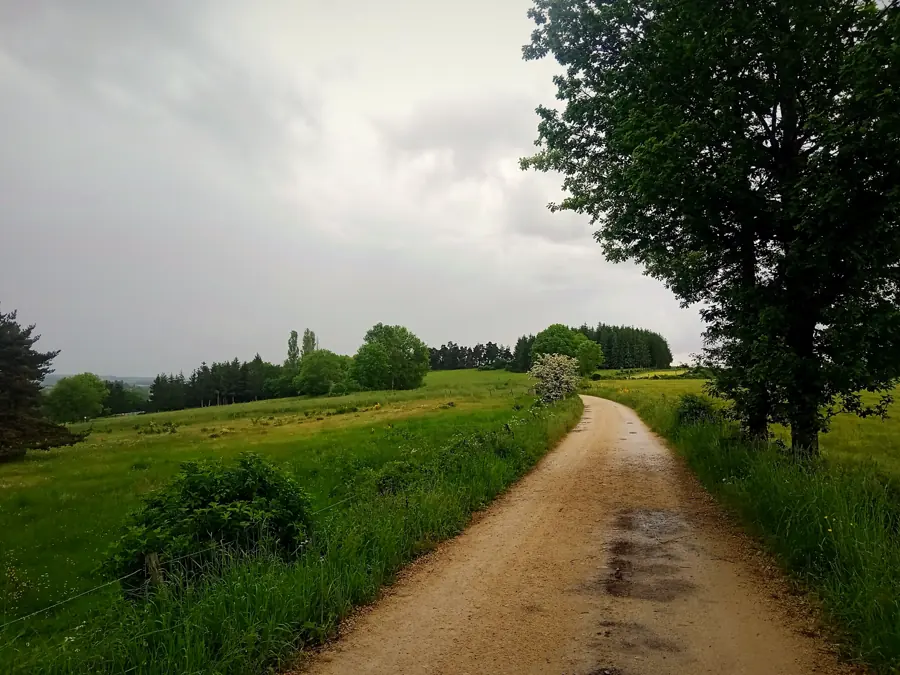
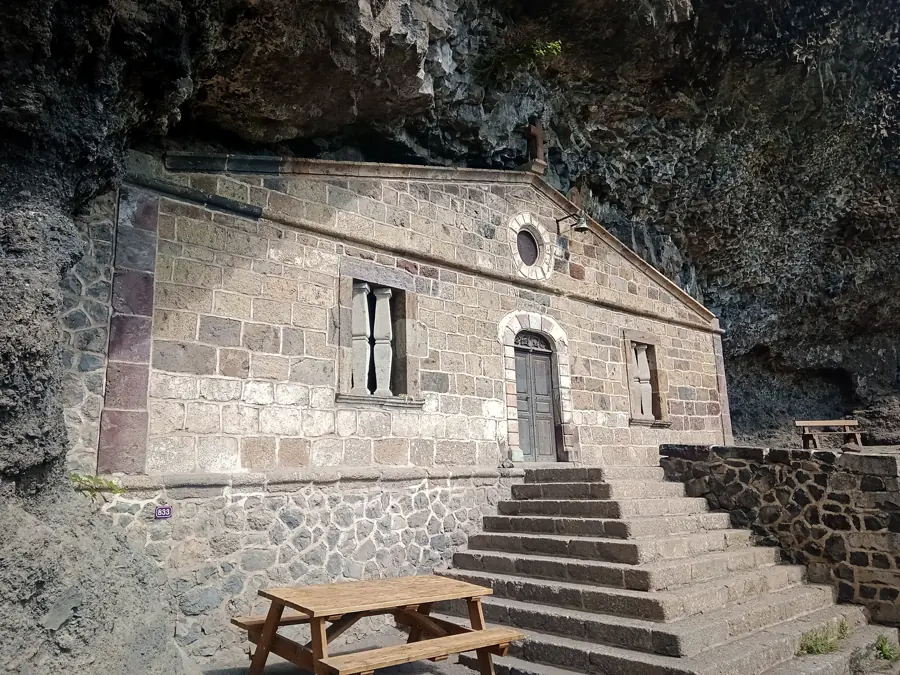
The second day of walking puts your pack to the test. From the Rochegude chapel, the GR65 drops roughly 350 m to Monistrol-d'Allier, zigzagging between trees and rocks. The official Haute-Loire route sheet says "caution!", and Podiensis records gradients of up to −19%. This is where poles and a light pack really spare your knees.
The next morning it is the other way round: 400 to 500 m of climbing over the first 4 to 6 km, with a handrail after the Madeleine chapel, then the Margeride plateau at around 1,050 to 1,100 m. There are no confirmed shops before Saugues; the route sheet lists three water points (Escluzels, Roziers, Le Vernet). Leave with 1.5 to 2 litres: full details are in our Monistrol-d'Allier to Saugues stage guide.
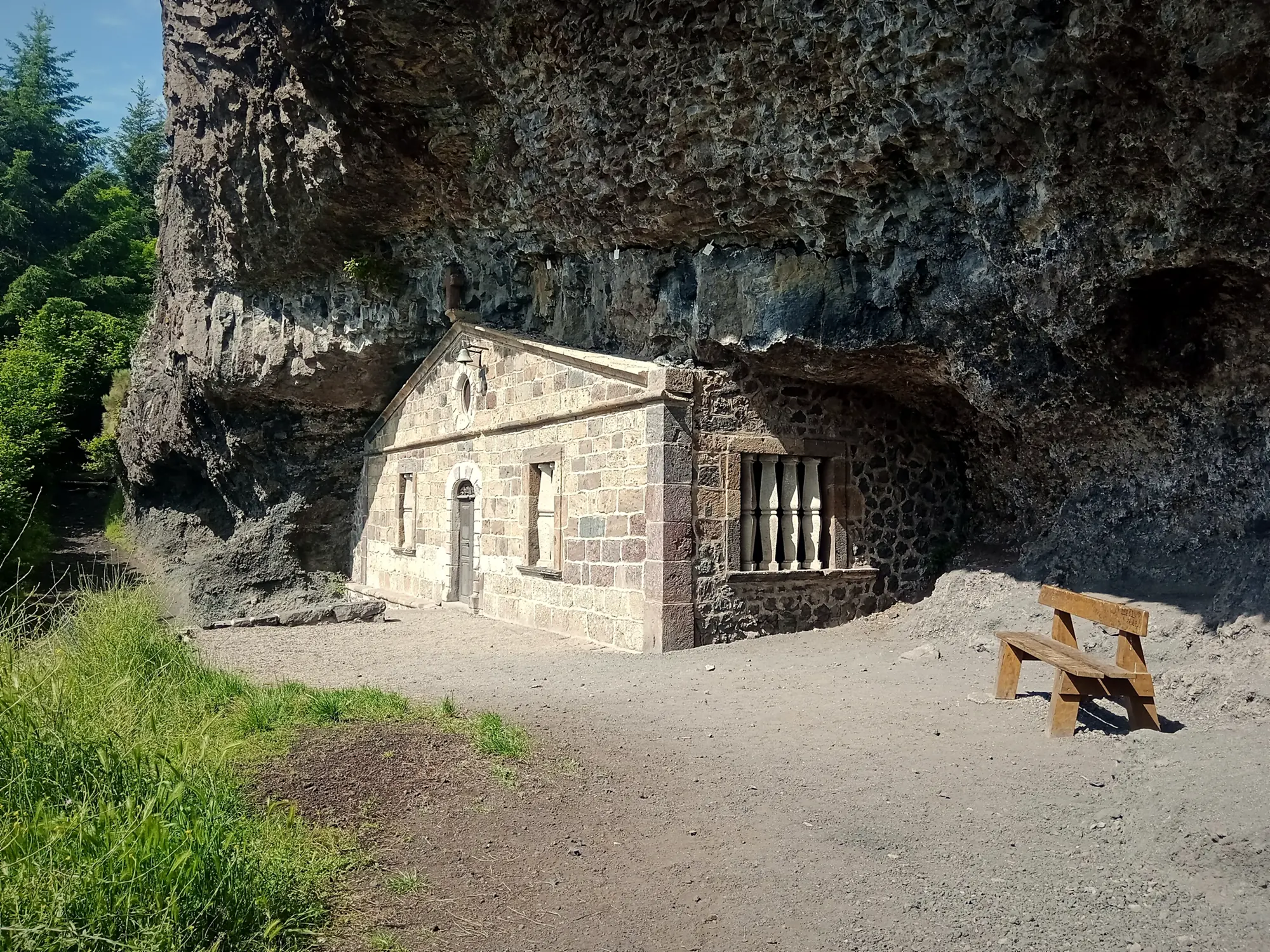
No ATM in Monistrol. The village has no cash machine and no pharmacy. Take out enough cash in Le Puy-en-Velay: the first ATMs on the route are in Saugues (Crédit Agricole and Caisse d'Épargne), which also has the first pharmacy.
To lighten your pack without going short: at L'Auberge des Amis the walker's breakfast (€9) is served from 6:30am, and a packed lunch to take away (€14) is available on request for a picnic on the Margeride. No need to carry two days of food from Le Puy.
Rain, wind and cold: dressing for the Margeride and Aubrac
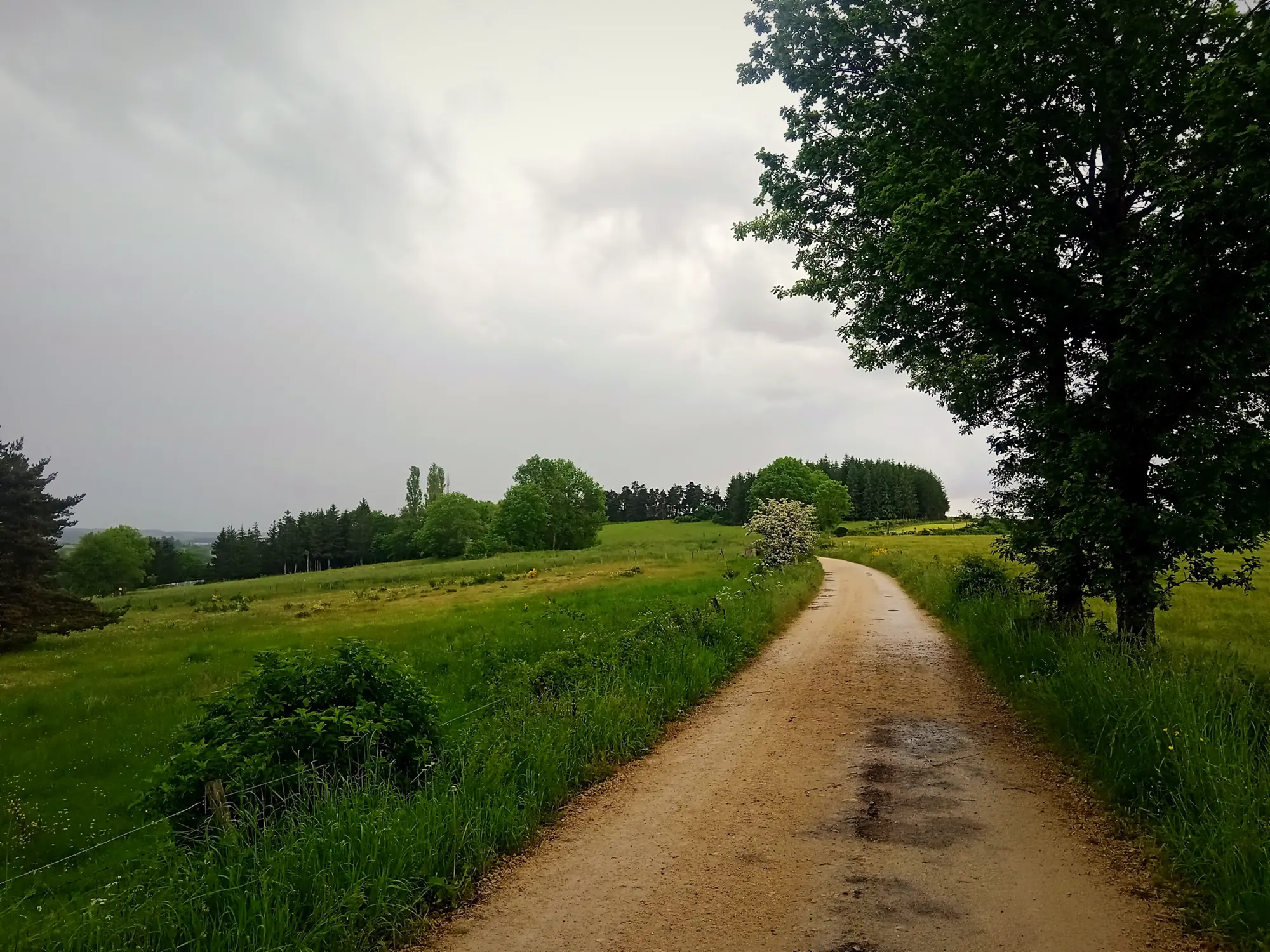
After the gorges, the trail stays high for a long time: the Margeride at around 1,100 m, then the Aubrac, whose village sits at 1,006 m. The French hiking site Randozone notes that the wind there is "often very present and fairly strong", that frosts are possible until June and that summer storms are frequent. So even in midsummer, keep a warm layer and a windproof in your pack. A poncho or cape, as Decathlon recommends, protects the pack as well. To choose the best season, see our guide to the best time to walk the Le Puy route.
Gîtes and bed bugs: good habits
A sleeping sheet is often requested in pilgrim accommodation, and it also protects your sleep. The Conques tourist office, on the GR65, gives five habits against bed bugs: do not put bags and belongings on the beds, remember they travel inside luggage, spray your belongings regularly with repellent, leave your shoes outside the sleeping area and wash your things at 60°C or more. Rules change from gîte to gîte, so ask when you book whether a sheet is provided or required.
Sending your pack ahead: luggage transport
If your back or knees complain, transport companies will move your bag from gîte to gîte. La Malle Postale (+33 4 71 04 21 79) covers the Le Puy route from Le Puy-en-Velay to Aire-sur-l'Adour; its 2026 season runs from 1 April to 31 October, and 2027 bookings open in December. For Le Puy to Conques, the Conques tourist office also lists Transbagages, Compostel'Bus and Transport du Levant, noting that the list is for information only. Check with the company that it serves your accommodation, Monistrol included, and ask about prices and the maximum weight per bag.
Even with luggage transport, keep a small daypack: water, snacks, rain gear, a warm layer, first-aid kit, documents and money.
A final check before you close the pack
Weigh the full pack with your bottle filled. If it is over 10% of your body weight, remove the "just in case" items first, then any duplicate clothes. The volunteers of the Amis de Saint-Jacques at Le Camino in Le Puy also give advice on pack weight before you set off. And if your route goes through the Allier gorges, a table is waiting at the bottom of the descent: book at the auberge or call +33 6 01 86 25 44.
Frequently asked questions
How heavy should my pack be on the Le Puy route?
The most widely quoted guideline is 10% of your body weight: 7 kg for a 70 kg walker, according to Decathlon and Viaje Camino de Santiago. The French hiking federation (FFRandonnée) sets the maximum at 20% for multi-day hikes. Sleeping in gîtes on the GR65, 10% is a realistic target.
Do I need a sleeping bag in the GR65 gîtes?
Usually not: accommodation generally provides beds and blankets. A sleeping sheet (sleeping bag liner) is, however, often requested. Rules vary from one gîte to another, so check when you book.
Hiking boots or trail runners?
There is no consensus. High-cut boots support the ankle better; low shoes are lighter and more flexible. The one piece of advice everyone agrees on: start with shoes you have already broken in.
Can I have my luggage transported on the Le Puy route?
Yes. La Malle Postale (+33 4 71 04 21 79) moves luggage along the Le Puy route, from April to the end of October in 2026. The Conques tourist office also lists Transbagages, Compostel'Bus and Transport du Levant between Le Puy and Conques. Book ahead.
Is there an ATM in Monistrol-d'Allier?
No. There is no ATM and no pharmacy in Monistrol. Take out enough cash in Le Puy-en-Velay: the first ATMs on the route are in Saugues, at Crédit Agricole and Caisse d'Épargne.
Photo credits — Chapelle Saint-Jacques de Rochegude © René Hourdry, CC BY-SA 4.0 (Wikimedia Commons) · Chapelle Sainte-Madeleine (Monistrol-d'Allier) © Rémih, CC BY-SA 4.0 (Wikimedia Commons) · GR65 trail Haute-Loire / Margeride © Rémih, CC BY-SA 4.0 (Wikimedia Commons) · GR65 trail Haute-Loire / Margeride © Rémih, CC BY-SA 4.0 (Wikimedia Commons) · Le Puy-en-Velay cathedral © Daniel Villafruela., CC BY 3.0 (Wikimedia Commons)