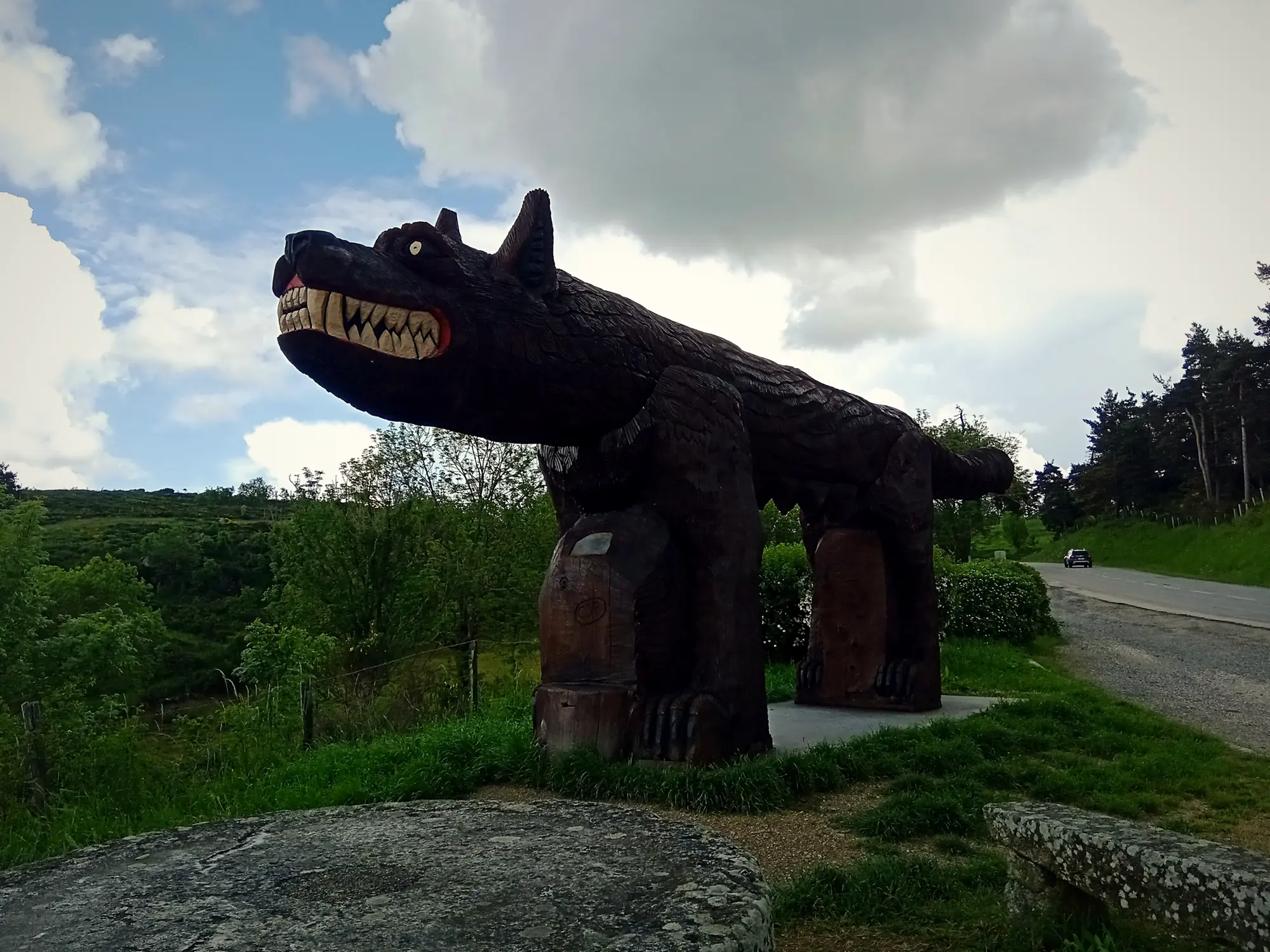
The Beast of Gévaudan and Saugues are inseparable. Between the summer of 1764 and 19 June 1767, one or more animals killed around a hundred people (88 to 124 depending on the count) in this corner of the Margeride, until Jean Chastel shot a large wolf-like animal near Auvers. Today Saugues, at 960 m on the GR65 and about 19 km from Monistrol-d'Allier, tells the story in its Fantastic Museum of the Beast of Gévaudan (22 scenes, open mainly in summer) and under the gaze of a huge carved Beast that towers over the town.
Most people think they know the Beast from a film or a novel. The archives tell a simpler and grimmer story: children guarding flocks, isolated parishes, and a royal court that eventually got involved. Here is what is established, what belongs to legend, and how to turn it into a good day out from the Allier gorges.
What happened in the Gévaudan between 1764 and 1767?
The Gévaudan was an old French province covering most of today's Lozère plus part of Haute-Loire. Saugues was one of its fortified towns, in the heart of the Margeride hills. In this landscape of high plateaus, pine woods and scattered hamlets, the attacks went on for three years. The key dates, according to documented history:
- 30 June 1764 Les Hubacs, Vivarais Jeanne Boulet, aged 14, is the first officially recorded victim. Her burial record blames "the ferocious beast". Other sources place the start of the attacks in July 1764.
- Autumn 1764 – April 1765 The king's dragoons Captain Duhamel and 56 dragoons of the Légion de Clermont-Prince scour the country without success. They leave on 8 April 1765.
- 12 January 1765 Le Villaret, Chanaleilles A group of children led by Jacques Portefaix fights the Beast off. Louis XV rewards them and pays for the boy's education.
- February – June 1765 The wolf hunters The king sends the d'Enneval father and son, professional wolf hunters, who reach Clermont-Ferrand on 17 February with their bloodhounds. In June they are replaced by François Antoine, the king's gun-bearer.
- 11 August 1765 Paulhac Marie-Jeanne Vallet, a servant, wounds the animal with a makeshift spear. She becomes known as "the Maid of Gévaudan".
- 20 or 21 September 1765 Chazes woods François Antoine shoots a large wolf near the Abbey of Chazes: about 1.7 m long and 60 kg. Stuffed, it is put on display at Versailles. For the court, the case is closed.
- 1766 – 1767 Margeride The attacks resume, but the king no longer wants to hear about them and the newspapers fall silent. Hunts are left to the local lords.
- 19 June 1767 La Sogne d'Auvers During a hunt organised by the Marquis d'Apcher, Jean Chastel kills a wolf-like animal on the slopes of Mont Mouchet. The attacks stop.
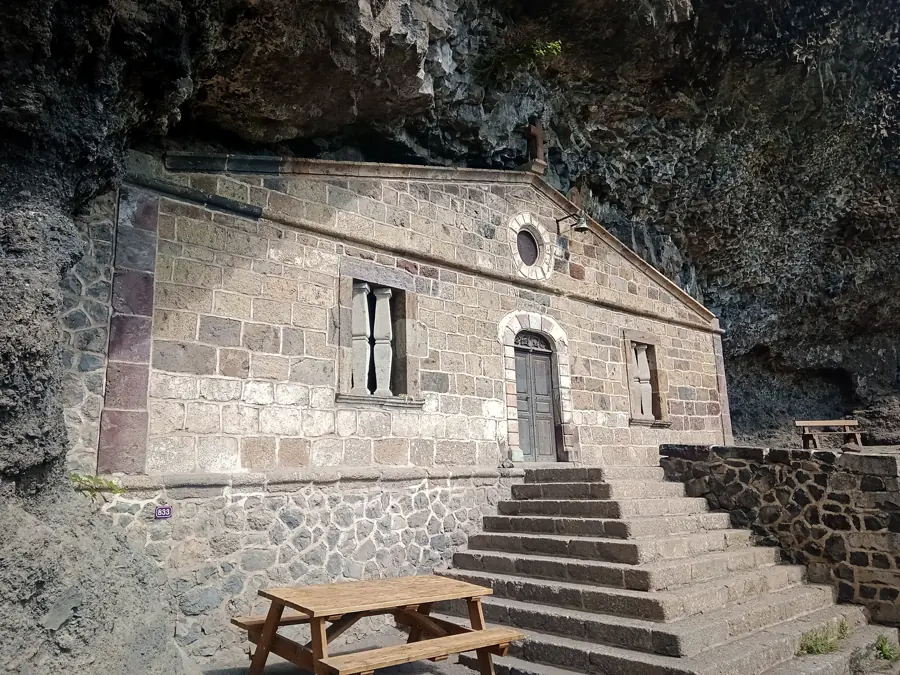
A detail few visitors know: in 1767 a great procession climbed to the chapel of Notre-Dame d'Estours, in the Seuge gorges, to pray to the Virgin for protection from the Beast. The painted statue carried that day now stands in the church of Monistrol-d'Allier. So you can start your investigation in the village before heading to Saugues.
The history of the Beast of Gévaudan: fact, legend and theories
The Beast has fed two centuries of novels, films and theories. It pays to sort them out.
Documented: the dates, the places, the names of many victims, the dragoons and then the king's hunters, the Chazes wolf sent to Versailles, the animal killed by Chastel in 1767. Legend: the silver or blessed bullet, the medals of the Virgin and Chastel's prayers before the shot. These details come from later tradition and literature (notably Henri Pourrat), not from 18th-century archives. Hypothesis: the exact nature of the animal, or animals.
On that last point, the view most widely held by historians is that the "Beast" was in fact several wolves that had turned man-eater. This is the reading of Abbé François Fabre, Guy Crouzet, Félix Buffière and Jean-Marc Moriceau, professor of early modern history at the University of Caen. In his work on wolf attacks in France (about 3,000 cases recorded from the 15th to the 20th century), he places the Gévaudan among other comparable episodes, some of them even deadlier.
Other, minority ideas have been put forward: a dog or a wolf-dog hybrid, an escaped big animal (a lion or a hyena), or an animal trained to kill. As for a human killer in disguise, an idea popularised by novels, no document supports it. A good rule when you read a new "revelation" about the Beast: ask which archive it rests on.
How do you get from Monistrol-d'Allier to Saugues?
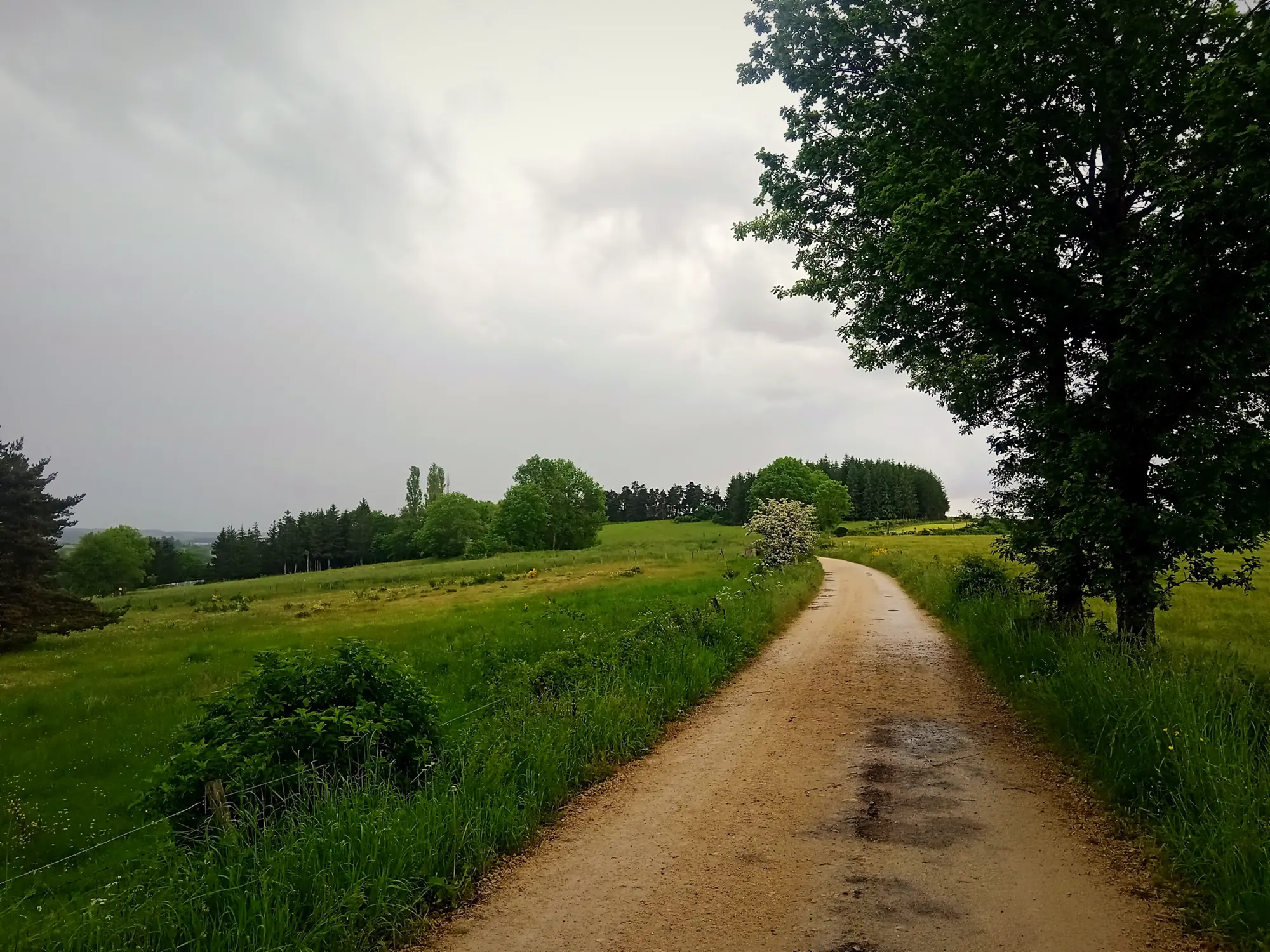
On foot, it is the next stage of the GR65: 12 to 13.5 km, 3.5 to 5 hours, with a long climb past the Madeleine chapel and Escluzels, then the Margeride plateau via Roziers and Le Vernet before dropping down to Saugues. All the details (water points, elevation, tricky waymarking) are in our guide to the GR65 stage from Monistrol-d'Allier to Saugues. There are no shops between the two villages, so carry water and food.
By car, Saugues is about 19 km away on the D589, roughly twenty minutes, more on this winding gorge road. By bus, regional line H04 Saugues – Monistrol-d'Allier – Le Puy-en-Velay links the two. It makes an ideal outing for a rest day in Monistrol: a morning or afternoon round trip and you are back in time for dinner.
What to see in Saugues on the trail of the Beast
The Fantastic Museum of the Beast of Gévaudan
Tucked into a lane opposite the Tour des Anglais, the Musée fantastique de la Bête du Gévaudan opened in 1999. It is not an archive museum but a staged walk-through on four floors: 22 plaster scenes, hand-sculpted by Blandine Gires and her father Lucien Gires, with dark corridors, sound and light. The visit takes about 35 minutes. Children love it, though the youngest may find it scary.
- Address: rue de la Tour, 43170 Saugues · +33 4 71 77 64 22.
- Opening (official Haute-Loire tourism listing): 15–30 June and 1–15 September, 2:30–6:30 pm; 1 July–31 August, 10 am–12 noon and 2:30–6:30 pm. Groups all year by appointment.
- Prices: not given on the official listing; an online guide quotes €6 for adults and €4 for children, to be checked on site.
The giant wooden Beast
You cannot miss it: a huge wooden statue of the Beast of Gévaudan looms over the town from the viewpoint on the D589. It is the work of Jean-Pierre Coniasse, a Saugues sculptor who has carved several successive Beasts for the town since 1995. The version commissioned by the council in 2022, in sequoia, was announced at 10.5 m tall and some fifteen tonnes. The same artist has placed around ten works in the town and along the Way of St James: a clog, a washerwoman, Saint Francis Regis and more. Keep your eyes open as you walk through.
The collegiate church of Saint-Médard and the Tour des Anglais
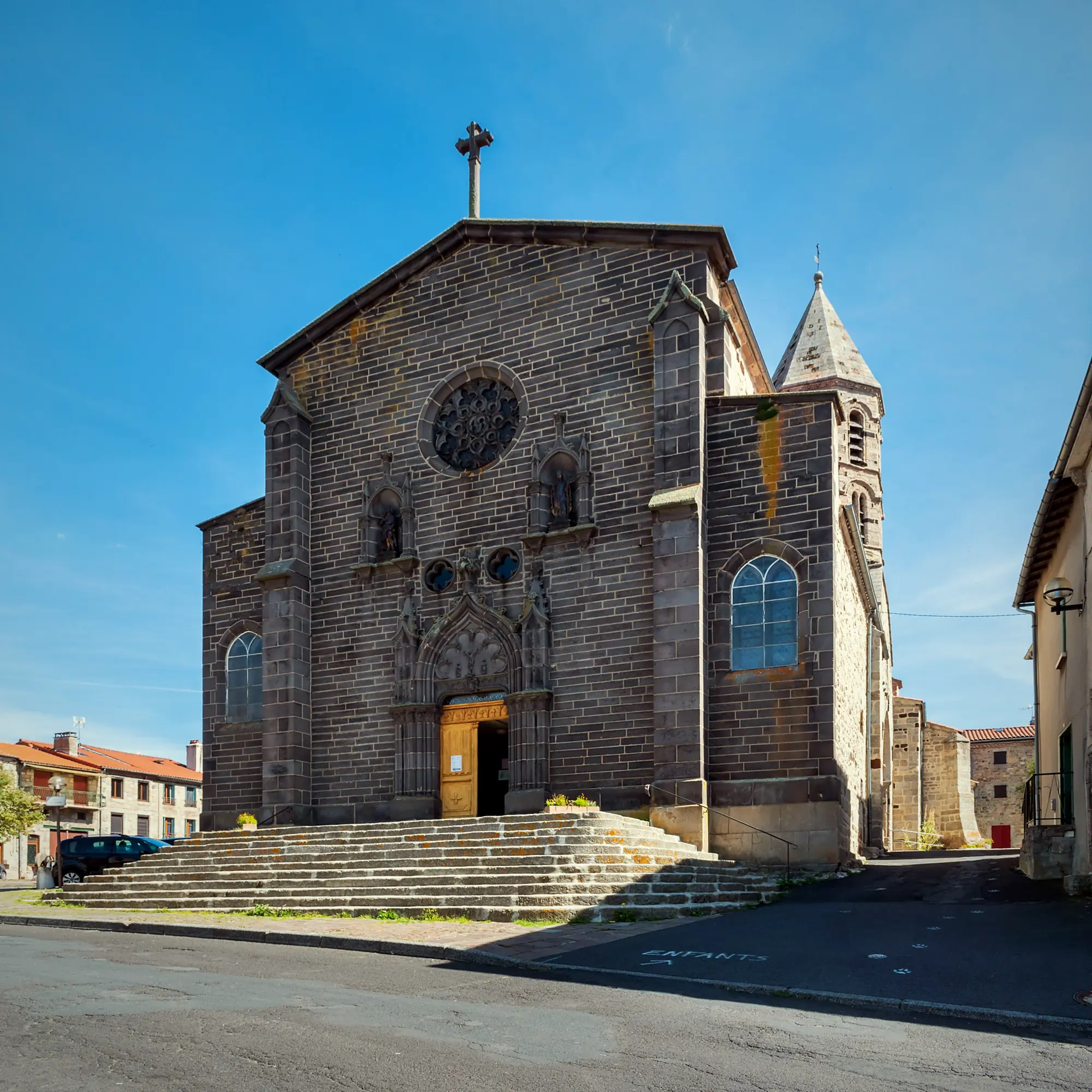
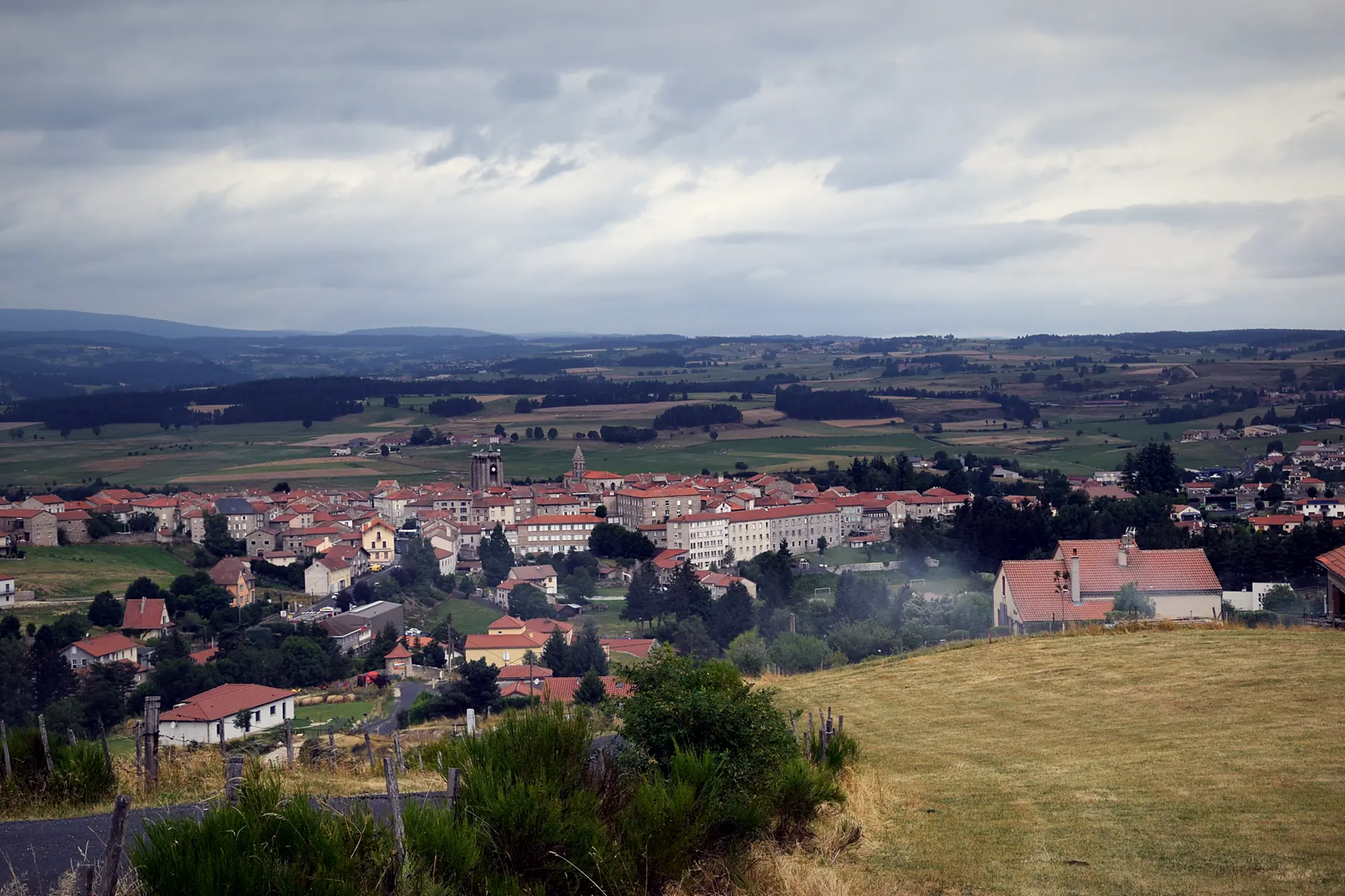
The collegiate church of Saint-Médard combines a Romanesque porch tower, listed as a historic monument as early as 1840, with a building reworked up to the 19th century (the church itself has been listed since 1971). Its treasury is worth the stop: a 12th-century Virgin in Majesty, a 15th-century pietà, Renaissance processional crosses by Le Puy goldsmiths and the reliquary of Saint Bénilde. Entry is free. Pilgrims are welcomed there from 5 to 6:30 pm, April to mid-October.
Close by, the Tour des Anglais, a square keep dated to the 13th century (some sources say the 14th) and the last remnant of a castle burned in 1788, has been a listed historic monument since 1907. Its terrace looks out over the Margeride. Check opening times with the tourist office.
Other Beast sites around Saugues
- Auvers: it was in this commune, at La Sogne d'Auvers near Mont Mouchet, that Chastel killed the animal in 1767. The village has a sculpture by Philippe Kaeppelin showing Marie-Jeanne Vallet facing the Beast.
- La Besseyre-Saint-Mary: a stele honouring Jean Chastel was put up here in July 1995.
- Le Villaret and the Domaine du Sauvage (Chanaleilles): the hamlet of Jacques Portefaix's fight and, on the GR65 beyond Saugues, the Domaine du Sauvage, a starting point for short walks in the Margeride.
- Monistrol-d'Allier: the statue of Notre-Dame d'Estours, carried in procession in 1767, inside the village church.
Practical tips for your visit
- When to go: mid-June to mid-September if you want the museum open. In July and August, mornings are quieter. Every August Saugues also hosts the Festival celte en Gévaudan, when the town is very lively.
- Friday morning is market day in Saugues, a good moment to combine sightseeing and shopping.
- Pilgrims: Saugues has cash machines and a pharmacy, which Monistrol lacks. Stock up.
- With children: tell them the story before you go in; the museum is dark and sometimes dramatic.
- Out of season: the statue, the church and the town remain accessible; only the museum is closed to individual visitors.
Tip from the auberge: if you are driving, have the walker's breakfast (€9, from 6:30 am), visit Saugues in the morning and come back for the €22 lunch menu (12–2 pm). If you are walking, order a packed lunch (€14) the day before, as there is nowhere to buy food before Saugues. For dinner on your return, book a table. And if you are staying on, see our ideas for making the most of the Allier gorges.
Frequently asked questions
Where is the Beast of Gévaudan museum?
The Musée fantastique de la Bête du Gévaudan is in Saugues (43170), rue de la Tour, opposite the Tour des Anglais. Phone: +33 4 71 77 64 22. Allow about 35 minutes for its 22 scenes.
When is the Saugues museum open?
The official Haute-Loire tourism listing gives 15–30 June and 1–15 September (2:30–6:30 pm), then 1 July to 31 August (10 am–12 noon and 2:30–6:30 pm). Groups are welcome all year by appointment. Call ahead, as hours can change from year to year.
How many people did the Beast of Gévaudan kill?
Around a hundred between 1764 and 1767. Counts vary: 88 to 124 deaths depending on the source, while a 1987 study lists 210 attacks, 113 deaths and 49 injured. The exact figure cannot be fixed.
Who killed the Beast of Gévaudan?
On 19 June 1767, Jean Chastel shot a wolf-like animal at La Sogne d'Auvers, on the slopes of Mont Mouchet, during a hunt organised by the Marquis d'Apcher. The attacks stopped afterwards. The blessed or silver bullet comes from literature, not from the archives.
Can you walk from Monistrol-d'Allier to Saugues?
Yes, on the GR65: 12 to 13.5 km and 3.5 to 5 hours, with a long climb out of Monistrol. By car it is about 19 km, roughly twenty minutes on the D589. Regional bus line H04 also links the two villages.
Photo credits — Saugues © Rémih, CC BY-SA 4.0 (Wikimedia Commons) · Saugues © Tournasol7, CC BY-SA 4.0 (Wikimedia Commons) · Saugues © Chatsam, CC BY-SA 3.0 (Wikimedia Commons) · GR65 trail Haute-Loire / Margeride © Rémih, CC BY-SA 4.0 (Wikimedia Commons)